





Can You Use an Extension Cord to Charge an EV? (2026)

Direct answer: You usually don't need one, and a household extension cord is never OK. If your outlet is out of reach, a longer charger cable or an outlet moved closer is the better fix. If you do use an extension cord, use a heavy-duty cord built for the circuit: matching NEMA plug and receptacle, rated for the full circuit, and as thick as practical. 6 gauge is best, and never thinner than 10 gauge on a 30A dryer outlet or 6 gauge on a 50A outlet.
- What safety groups say: the Electrical Safety Foundation (ESFI), the U.S. Fire Administration, Tesla, and Chevrolet all say not to charge through an extension cord.
- The better fix: a charger with a longer cable (many are 18 to 25 feet) or an electrician-installed outlet near where you park.
- If you use one anyway: one cord, matching plug, rated for the whole circuit, 25 feet or less, fully uncoiled.
- Gauge: 10 AWG minimum on a 30A dryer outlet, 6 AWG on a 50A outlet. A smaller gauge number means thicker wire.
- Never: an orange household cord, a power strip, a chain of cords or adapters, or a cord run through a wall, door, or window.
Checked October 14, 2026 against ESFI and U.S. Fire Administration charging guidance, Tesla's Mobile Connector manual, Chevrolet's charge cord instructions, and National Electrical Code Articles 400 and 625.
The usual problem is an outlet in the wrong place: at the back of the garage, or behind the dryer. An extension cord looks like the obvious answer, but it's the riskiest one. EV charging pulls a steady, heavy current for hours, and every extra plug and foot of wire adds heat. Here's why, what to do instead, and how to pick a cord built for the job if you still use one.
Related: Is it safe to charge an EV from a dryer outlet? · Level 1 vs Level 2 charging speed · EV charger breaker size and wire gauge · What it costs to install an EV charger
Do you actually need an extension cord?
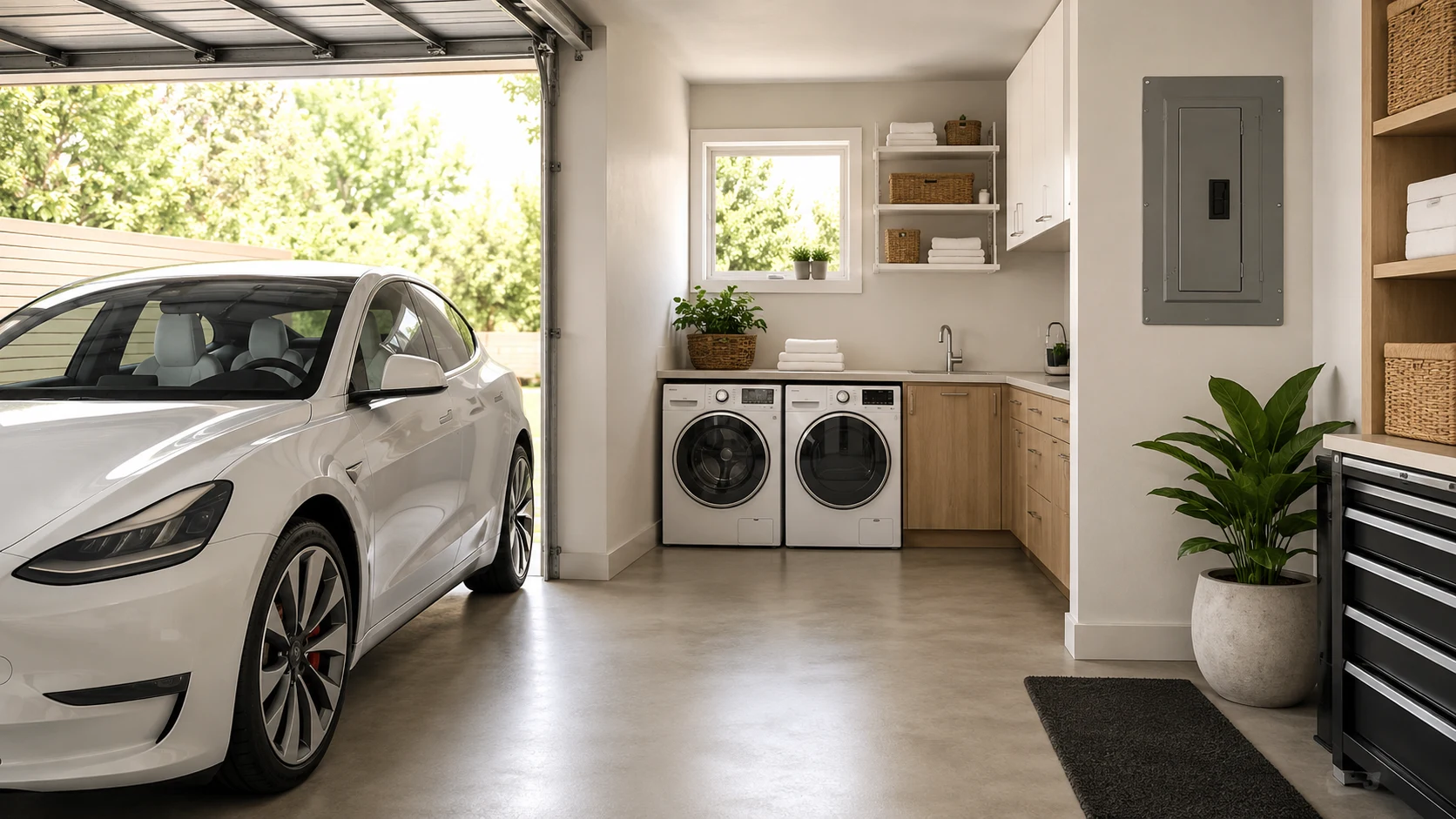
Probably not. Measure the real distance from the outlet to your car's charge port, along the path the cable would take, and compare it with your charger's cable.
- Tesla's Mobile Connector reaches 20 feet with the adapter installed, per Tesla's manual.
- Many plug-in Level 2 chargers come with 18 to 25 foot cables.
- Parking closer, or backing in so the charge port faces the outlet, often closes the gap for free.
If the gap is still too big, the permanent fixes are a charger with a longer cable or an outlet moved closer to where you park.
Why extension cords cause problems with EV charging
It's a continuous load. A drill draws power for minutes. An EV draws its full current for hours, usually overnight. The National Electrical Code treats EV charging as a continuous load, which is why a 30A dryer circuit is limited to 24A of charging and a 50A circuit to 40A.
Heat builds at the connections. An extension cord adds two plug-and-receptacle joints. Each has a little contact resistance, and that turns current into heat right where the metal touches. A slightly loose or worn contact runs hotter, the heat loosens it further, and the cycle repeats. That's how plugs melt.
The wire warms up too. Thinner and longer cords have more resistance, so they make more heat. A coiled cord traps it.
Wear adds up. Cords on garage floors get stepped on, pinched, and run over, and plugs pulled daily loosen.
How much heat a 25-foot cord makes
Here's the arithmetic, using copper resistance values from the National Electrical Code's conductor table (Chapter 9, Table 8, stranded copper at 75°C). Current flows out and back, so a 25-foot cord puts 50 feet of conductor in the circuit.
| Cord | Charging current | Voltage drop | Heat in the cord |
|---|---|---|---|
| 10 AWG, 25 ft | 24A (30A circuit) | about 1.5 V | about 36 W |
| 8 AWG, 25 ft | 24A | about 0.9 V | about 22 W |
| 6 AWG, 25 ft | 24A | about 0.6 V | about 14 W |
| 6 AWG, 25 ft | 40A (50A circuit) | about 1.0 V | about 39 W |
| 10 AWG, 50 ft | 24A | about 3.0 V | about 71 W |
Voltage drop at 240V is small and won't hurt the car; heat is the point. Going from 10 AWG to 6 AWG cuts the heat in the wire by more than half, and doubling the length doubles it. The table covers only the wire. The plug connections add more, and that's where problems usually start.
What safety groups, Tesla, and GM say
The official guidance is consistent:
- ESFI: never use an extension cord or multi-plug adapter when charging an EV.
- U.S. Fire Administration: plug Level 1 chargers directly into an outlet that can handle the charger's current, and never use a multi-plug adapter or extension cord.
- Tesla: the Mobile Connector manual warns against plugging in through an extension cord, multi-outlet adapter, multi-plug, conversion plug, or power strip.
- Chevrolet (GM): the Dual Level Charge Cord instructions say "Do not use with an extension cord."
So using a cord means going against your charger maker's instructions. Check your own charger's manual and warranty terms first, because using equipment against the manual can affect warranty coverage.
Tesla owners: the Gen 3 Mobile Connector charges at 12A on a NEMA 5-15 household outlet, 24A on a 14-30 or 10-30 dryer outlet, and 32A on a 14-50 or 6-50, and the manual's extension cord warning makes no exception for any of them. If 20 feet doesn't reach, look at an outlet closer to parking or a hardwired charger such as Tesla's Wall Connector.
Level 1 vs Level 2: does a 120V charger change the answer?
Level 1 draws less current, so the risk is lower. It isn't gone.
Level 1 (120V household outlet). A typical Level 1 cord draws 12A, and because Level 1 is slow, it often draws it all night. Light-duty household cords aren't meant for that. Some Level 1 charge cords also have a temperature sensor in the wall plug; Chevrolet says its plug has thermal sensors, where regulations allow, to reduce the chance of overheating there. Plug that charger into an extension cord and the sensor watches the cord's receptacle, not your wall outlet.
If you use a cord for Level 1 anyway, the same rules apply: one heavy-duty, three-prong grounded cord, an amp rating on the label that covers the full circuit (15A, or 20A on a 20A circuit), as short as possible, and fully uncoiled.
Level 2 (240V). Current doubles or more: 24A on a 30A dryer circuit, 40A on a 50A circuit, so the cord needs the outlet's exact NEMA configuration and the gauge below.
Extension cord gauge by circuit
AWG works backwards: a smaller number means thicker wire, which runs cooler.
| Outlet | Circuit | Max continuous EV charging | Minimum cord | Better choice |
|---|---|---|---|---|
| NEMA 5-15 or 5-20 (household, Level 1) | 15A or 20A, 120V | 12A or 16A | Heavy-duty, grounded, rated for the full circuit | Shortest cord that reaches |
| NEMA 14-30 or 10-30 (dryer) | 30A, 240V | 24A | 10 AWG, matching ends | 8 or 6 AWG, especially on longer runs |
| NEMA 14-50 or 6-50 (range or EV outlet) | 50A, 240V | 40A | 6 AWG, matching ends | 6 AWG, 25 ft or less |
- Match the configuration exactly. A 14-30 cord for a 14-30 outlet, a 10-30 for a 10-30. Never use an adapter to change the shape.
- Rated for the circuit, not the charger setting. A charger set to 16A on a 30A outlet still needs a cord rated for 30A.
- Three-prong 10-30 outlets have no separate ground wire. Have an older one checked; see our NEMA 10-30 guide.
- 14-50 and 6-50 aren't interchangeable. See NEMA 14-50 vs 6-50.
What about "EV-rated" extension cords?
There's no special "EV-rated extension cord" category in the National Electrical Code to rely on. The code does set rules for a charger's own cables: NEC 625.17 calls for a hard-service or junior hard-service supply cord and a listed EV-type output cable (such as Type EV or EVJ), and caps the usable cable length at 25 feet unless a cable management system is part of the listed equipment. Those rules cover the charger as tested and listed, not a cord you add.
On a product listing, "EV extension cord" usually just means a heavy 240V cord with NEMA ends. Check what you can verify:
- a listing mark from a recognized lab (UL, ETL, CSA) on the cord itself
- a plug and receptacle that match your outlet and your charger
- an amp rating at or above the circuit breaker
- the wire gauge printed on the jacket
- an outdoor-rated jacket for garages and driveways (a "W" in the cord type, such as STW or SJTW)
- a length of 25 feet or less
J1772 or Tesla connector extension cables extend the charger's cable at the car end instead. They aren't part of your charger's listing either, and they can push the total past the 25-foot limit in NEC 625.17. Ask your charger maker before using one.
If you use an extension cord: a checklist
- One cord only. No daisy-chained cords, adapters, splitters, or power strips.
- Built for the circuit: matching NEMA plug and receptacle, rated for the full circuit amps, 10 AWG or heavier on 30A, 6 AWG on 50A.
- 25 feet or less, fully uncoiled.
- Listed, with an outdoor or wet-rated jacket in a garage or driveway. Keep connections out of puddles and snow.
- Not through walls, doors, or windows. NEC 400.12 doesn't allow cords as a substitute for permanent wiring, or run through holes in walls, doorways, or windows.
- Not under a closing garage door or where it gets driven over. The code also bars cords where they're exposed to physical damage.
- Plugs fully seated, with nothing pulling on them.
- Check for heat. During the first few sessions, feel the plug ends and the wall plug while charging.
- Unplug and replace the cord if it's damaged, warm, discolored, or smells of hot plastic. Don't tape it up.
If you need a cord built to these specs, NeoCharge sells 25-foot heavy-duty cords: NEMA 14-30 and NEMA 10-30 in 10 AWG, rated for 24A (5.7 kW) on a 30A breaker, at $129, and NEMA 14-50 in 6 AWG, rated for 40A (9.6 kW) on a 50A breaker, at $149. Each product page lists UL file E257089. The checklist still applies, and your charger's manual still comes first.
Better alternatives to an extension cord
| Option | Fixes distance? | Helps if the dryer has your only 240V outlet? | Notes |
|---|---|---|---|
| Charger with a longer cable | Yes, up to 25 ft | No | Simplest fix; keeps everything in one listed product |
| Park closer or back in | Sometimes | No | Free. Try it first |
| Move or add an outlet near parking | Yes | Sometimes, on a new circuit | Electrician job; usually needs a permit |
| New dedicated circuit | Yes | Yes | Most flexible; depends on panel capacity |
| Smart Splitter on the dryer outlet | No | Yes | Shares the dryer circuit; the charger still has to reach the car |
| Hardwired charger | Yes, mounted where you park | On a new circuit | No plug to wear out |
Our installation cost guide covers what a new outlet or circuit typically involves.
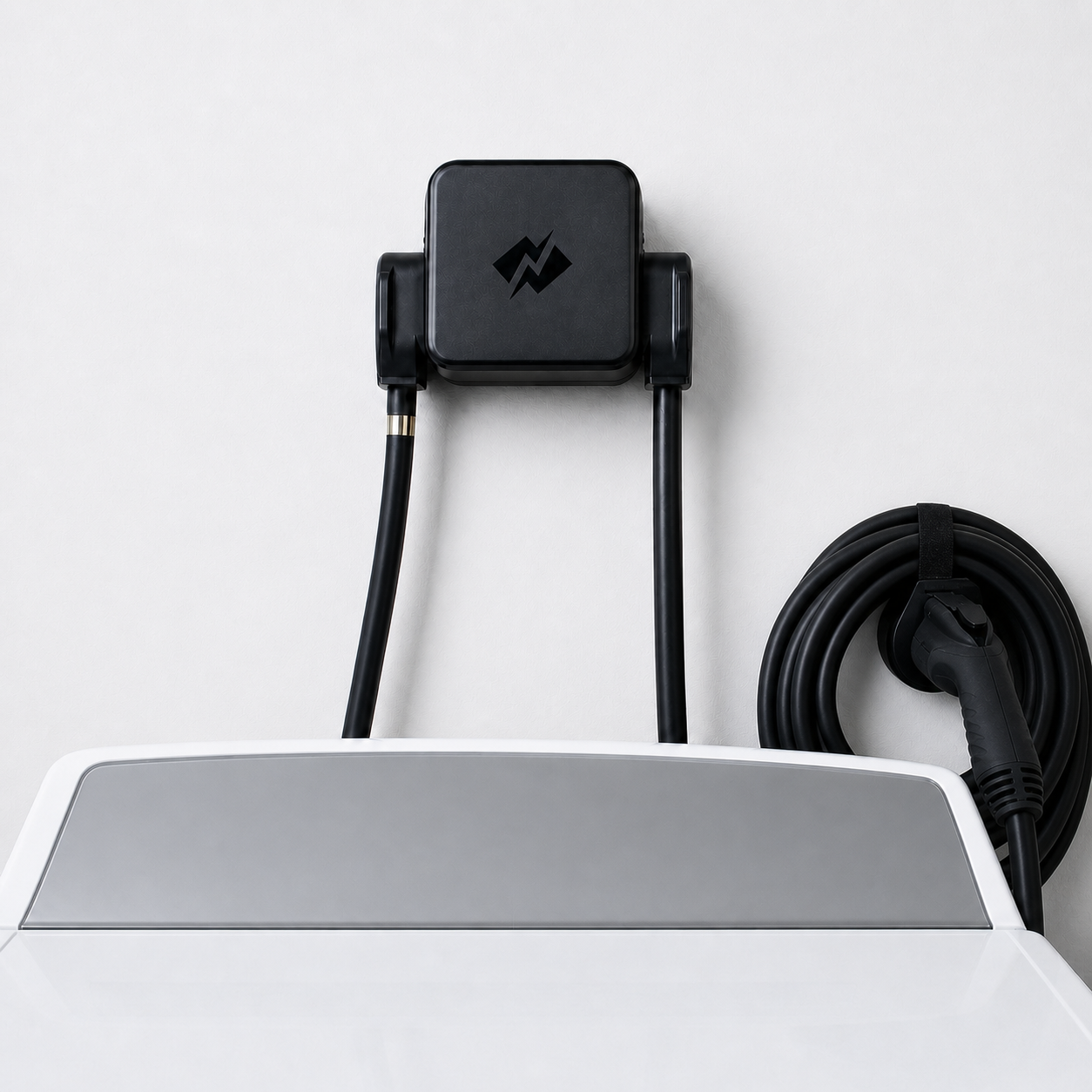
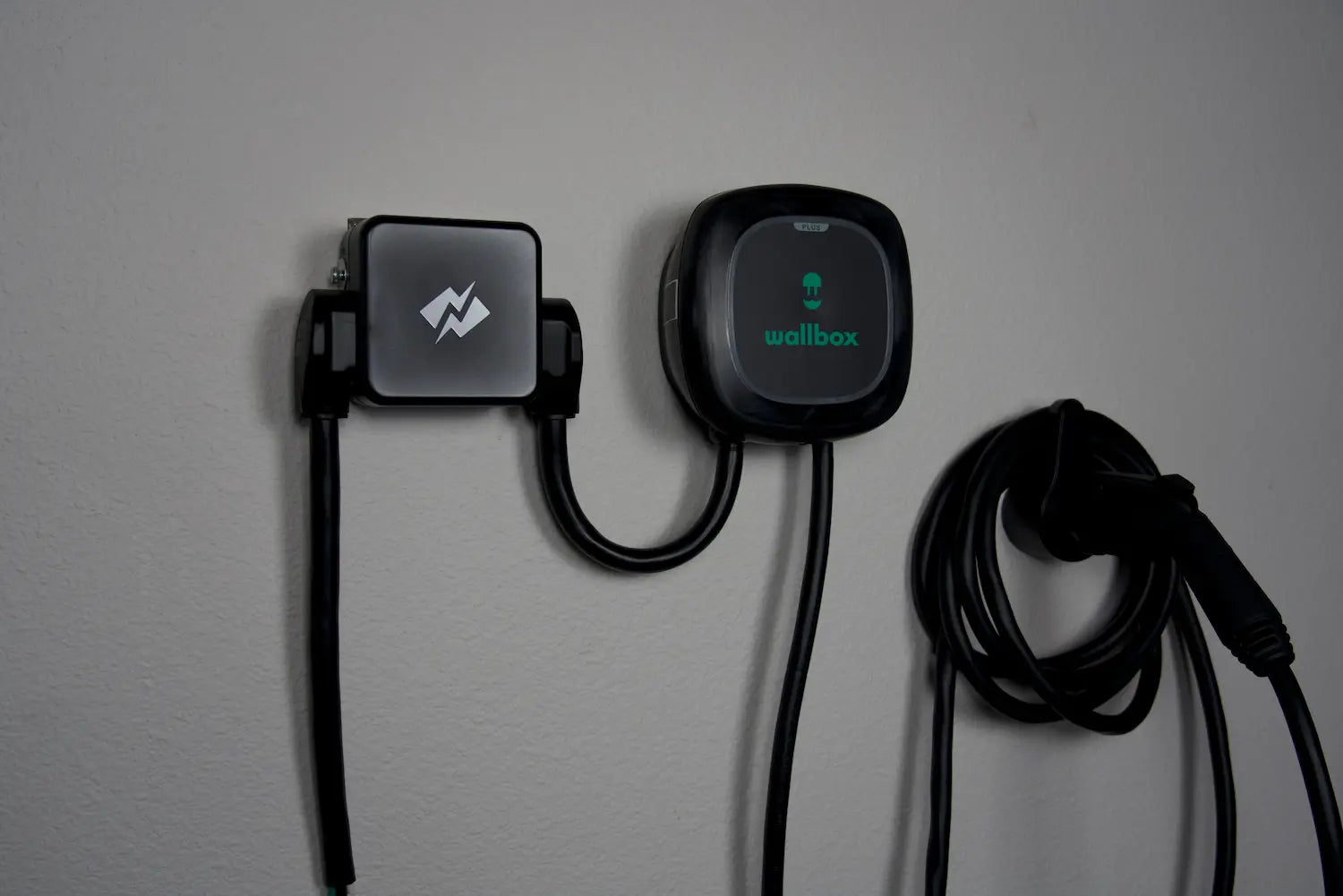
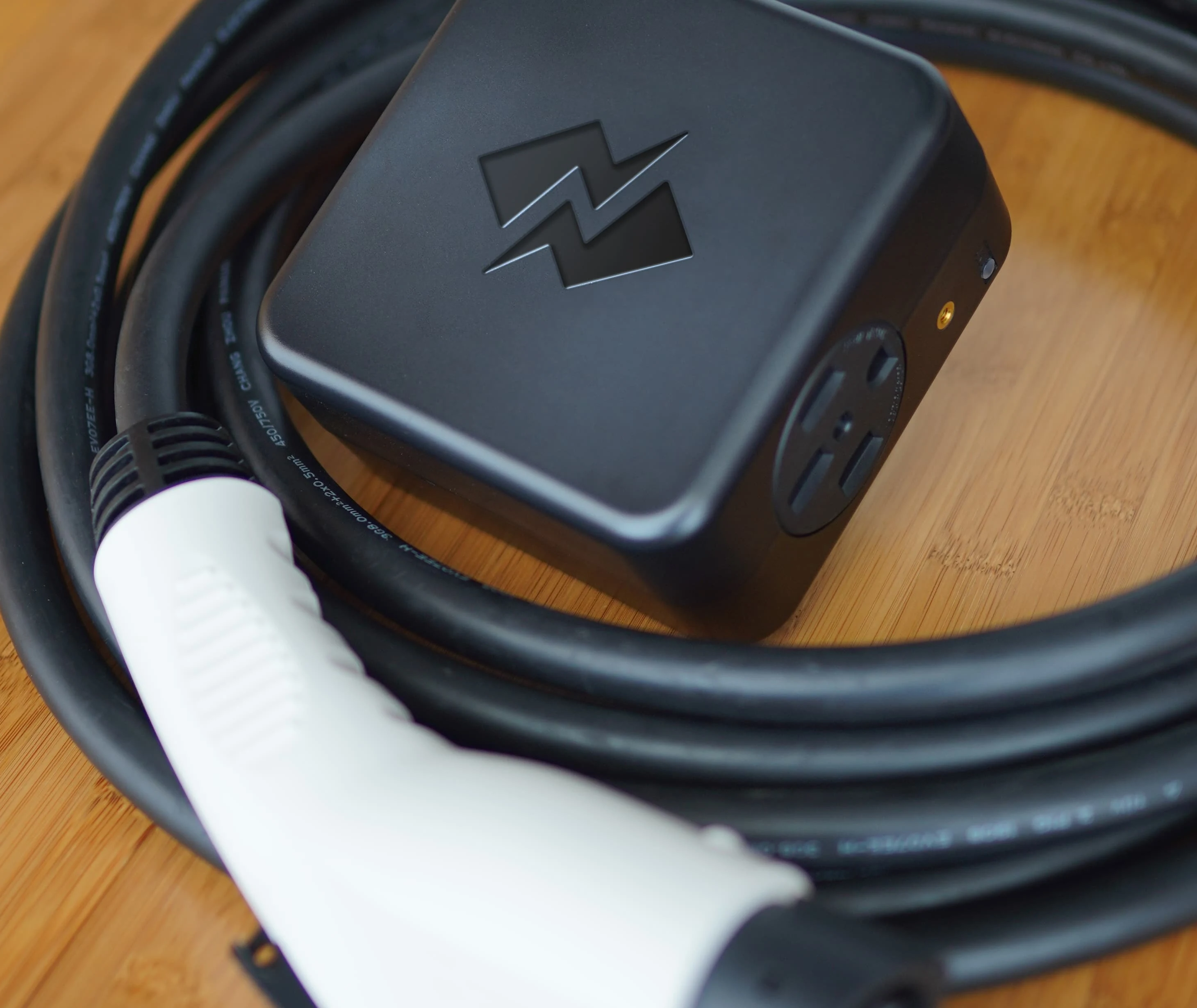
If the real problem is that the dryer has the only 240V outlet, a NeoCharge Smart Splitter plugs into the dryer outlet and gives you a second outlet for the charger. The dryer has priority: while it runs, the car pauses, and charging resumes when it stops. It doesn't add reach, though. If the car is far from the laundry, an outlet or circuit near parking is the better answer. See how to share a dryer outlet with an EV.
In Canada? The safety advice is the same. For dryer-outlet options there, see Can I charge my EV from a dryer outlet in Canada?
cUL Listed, plugs into your dryer outlet
Only 240V outlet is the dryer's?
The Smart Splitter shares the dryer circuit with your EV charger. The dryer gets priority and the car charges the rest of the time, with nothing to unplug. Works with plug-in Level 2 chargers that can be set to 24A or less on a 30A outlet. $399.
FAQ
Can I use an extension cord to charge my EV?
Can you use an extension cord with a Level 1 EV charger?
What gauge extension cord do I need for EV charging?
Is there such a thing as an EV-rated extension cord?
Can I use an extension cord to charge my Tesla?
Is a heavy-duty extension cord safe for EV charging?
Can I use a power strip or surge protector to charge my EV?
Will an extension cord void my EV charger warranty?
Bottom line
Don't start with an extension cord. Measure the gap, then fix it with a longer charger cable or an outlet near where you park. If the dryer has the only 240V outlet, a smart splitter shares it, but it doesn't add reach. If you still use a cord, use one heavy-duty cord built for the circuit (10 AWG minimum on 30A, 6 AWG on 50A), 25 feet or less, uncoiled, and checked for heat. Never a household cord.
Next steps (NeoCharge)
- Measure the outlet-to-port distance, then check your charger's cable length and manual.
- If the dryer is your only 240V outlet, see how the NeoCharge Smart Splitter shares it, and check the rebate finder.
- Need a cord built for the circuit? See NeoCharge's 25 ft 14-30, 10-30, and 14-50 cords.
- Planning a new outlet or circuit? Start with our installation cost guide.
Sources
Checked October 14, 2026:
- Electrical Safety Foundation (ESFI), Electric vehicle charging safety
- U.S. Fire Administration, Electric vehicles and EV charging safety tips handout
- Tesla, Mobile Connector Gen 3 owner's manual: extension cord warning, adapter ratings, 20 ft cable length
- Chevrolet, Dual Level Charge Cord supplement: extension cord warning and plug thermal sensors
- National Electrical Code section 400.12 (uses not permitted for flexible cords), as summarized by EC&M, Code Q&A: Where can you not use flexible cords and flexible cables?
- National Electrical Code Article 625 (625.17 cords and cables, 625.41 continuous load), as summarized by EC&M, The apprentice's guide to Article 625
- National Electrical Code Chapter 9, Table 8 (DC resistance of 1.24, 0.778, and 0.491 ohms per 1,000 ft for 10, 8, and 6 AWG stranded copper at 75°C), explained by EC&M, How to use Chapter 9 in your next design
- NeoCharge product pages: NEMA 14-30 extension cord, 25 ft, NEMA 10-30 extension cord, 25 ft, NEMA 14-50 extension cord, 25 ft
Update log: rebuilt and refreshed October 14, 2026 against current search results, with current safety-group and manufacturer guidance, a gauge-by-circuit table, a worked heat example, NEC 400.12 and 625.17 context, and a checklist for owners who use a cord.
Electrical safety disclaimer
This article is general information, not electrical advice. EV charging equipment must be installed and used according to the electrical code in force where you live, local permit rules, manufacturer instructions, and the judgment of a licensed electrician. If a plug, cord, or outlet is warm, discolored, or loose, stop using it and have it inspected.
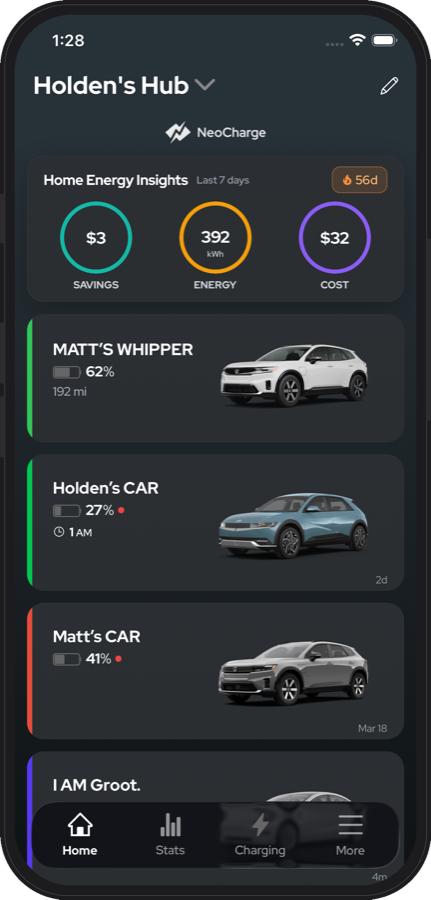
NeoCharge App
Track charging costs without spreadsheet work
See session history, monthly energy use, and savings so the article advice turns into a real household habit.
Explore the app

Next steps
Keep going with NeoCharge
Use the article as your decision guide, then jump into the product, app, or related guides that match what you are trying to solve next.
Key terms
- Level 2 charging
- Level 2 EV charging uses a 240V circuit (like a dryer outlet). It typically adds ~20–35 miles of range per hour, depending on your car and the circuit amperage.
- NEMA 14-50
- A NEMA 14-50 is a common 240V, 50A outlet (often used for EV charging). Many EV chargers plug into it, but the actual charging speed depends on the circuit and your EV.
- NEMA 14-30
- A NEMA 14-30 is a 240V, 30A dryer outlet. With a properly configured EV charger, it can usually support ~24A continuous charging (about 20–25 miles of range per hour for many EVs).
Related posts
EV Charging Best Practices: Battery Life, Safety, and Cost
Learn EV charging best practices for battery life, home safety, off-peak savings, fast charging, 80% limits, Level 2 charging, and panel upgrades.
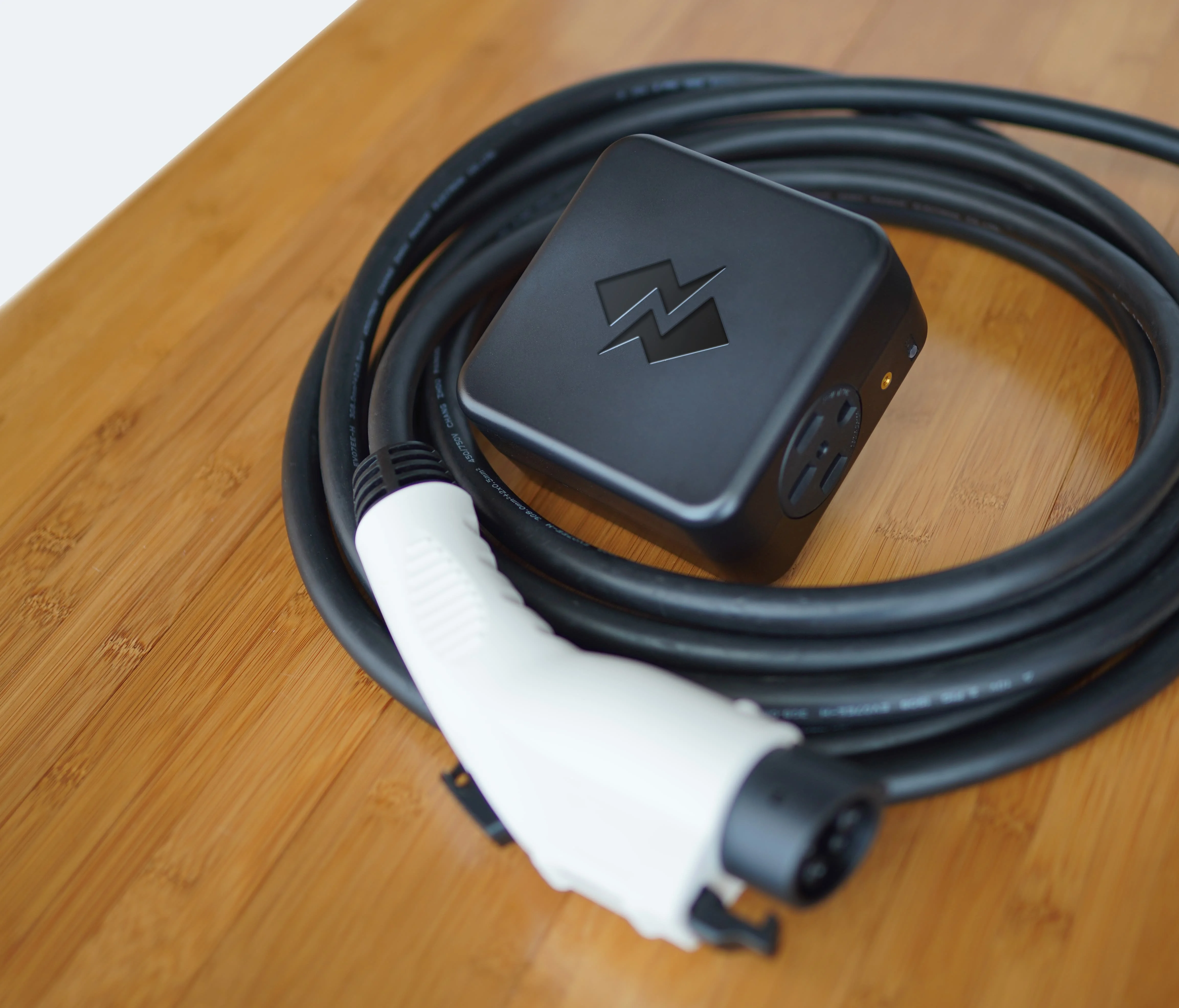
Smart Splitter vs EVEMS vs Panel Upgrade: How to Choose the Right Path for Level 2 Charging
Need Level 2 charging but worried about a panel upgrade? Compare Smart Splitter outlet sharing vs EV energy management (EVEMS) vs a full panel upgrade—with a simple decision tree.


Charging an EV with a NEMA 10-30 Dryer Outlet (Grounding, Adapters, and Safer Alternatives)
A NEMA 10-30 dryer outlet can work for EV charging—but grounding and adapter safety matter. Learn the 24A guideline, key risks, and safer alternatives.


How to Find Your Off-Peak Hours for EV Charging (TOU Rate Plans Made Simple)
Off-peak hours depend on your utility’s TOU rate plan (and seasons/weekends). Here’s how to find your schedule, turn it into a charging rule, and save money.
